icom_donate

Donate Today

icon_get_involved

Get Involved

icon_friend

Friends of

Positive preliminary results for brain tumour project

For the past 18 months, Friends of Rosie has funded a cutting-edge research project to improve treatment options for children with incurable brain tumours. As it moves into its final research phase, we can share some of the positive preliminary results in using immunotherapy to shrink or destroy brain tumours in children.

The Friends of Rosie Children’s Cancer Research Fund funds small-scale research projects to kick-start potential advances in the treatment and diagnosis of childhood cancer. This project, looking at childhood brain tumours, is being conducted at the Manchester Cancer Research Centre under the supervision of lead researchers, Professor Robert Hawkins and Dr Gray Kueberuwa.
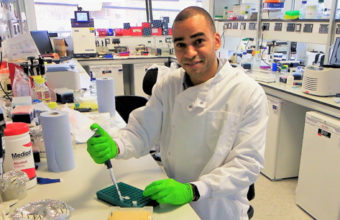
ImmunotherapySays Dr Kueberuwa, “The aim of this project is to investigate the possibility of using a child’s own immune system, called immunotherapy, to fight their brain tumour. There are many types of childhood brain tumours that don’t respond well to conventional treatments and so are currently incurable. This research is looking at the potential of immunotherapy to give children and parents a life-saving alternative where chemotherapy and radiotherapy has failed in the treatment of a child’s cancer.

“While the path to progressing this approach for use in patients has many challenges, preliminary results so far have given us a hope that this goal is achievable in the future.”

Brain tumours are particularly resistant to drug therapy

All projects funded by Friends of Rosie are reviewed by an independent scientific advisory board to ensure that money is being spent on the most promising and most needed areas of childhood cancer research. Following a recent review of this particular project, Professor John Hickman, Chair of the advisory board, commented on the potential long-term outlook for the research:

“Brain tumours are particularly resistant to drug therapy. This project investigates the possibility of a different approach by harnessing the body’s own immune system to attack the tumour. Immunotherapy has recently had an impact against previously incurable tumours, such as melanoma and some lung cancers. In fact, two pioneers of this approach received the 2018 Nobel Prize for Medicine and Physiology.

“The brain has previously been considered to be an immune sanctuary, with suppressed immune activity and few immune cells. Despite this, Professor Robert Hawkins and Dr Gray Kueberuwa of the University of Manchester, supported by Friends of Rosie, have successfully isolated immune cells from childhood brain cancers and expanded their numbers by growing them in the laboratory.

Hope for the future

“Preliminary data suggests that these expanded populations of immune cells recognise tumour cells and kill them. Ongoing work will investigate the effectiveness of these expanded populations of immune cells to selectively affect tumour growth in the laboratory, without effects on normal cells, with a long-term view to eventually reintroducing them into the brain for therapeutic gain. This will involve many further steps before a therapeutic use will be possible.”

The project is due for completion in Spring 2019, after which a full scientific report will be published to share the great potential of this approach. The project may enable the development of a key new area of childhood cancer treatment and could save the lives of children with brain tumours in the future.

Nancy Dykes

Nancy Dykes

Nancy, 11, was diagnosed with rhabdomyosarcoma when she was just 2 years old. She was treated with Proton Beam Therapy (PBT) in Germany but unfortunately relapsed less than a year later. The family were then sent to Germany for a second round of PBT. Although treatment helped to cure Nancy’s cancer, she has been left with lots of lasting effects which will require ongoing treatment throughout her life. Here Nancy and her mum, Antonia, share their story in the hope it will help others, raise awareness, and raise more money for children’s cancer research.

Prof John Hickman

Prof John Hickman

Why I am a Trustee of CCRF
 
I am a relative of the Larkin family and knew Rosie Larkin ( Friends of Rosie, now CCRF) when she had and then died of neuroblastoma, aged six. At that time, I was a scientist and professor at Manchester University, actively working on the problem of why some cancers do not die despite intensive and toxic therapies.  Seeing Rosie during her unsuccessful therapy and then attending her funeral, besides being emotional, drove me to double down on my own research as well as to support the Charity as best I could as a cancer researcher. I spent over a decade as the Chairman of the Scientific Advisory Board of the CCRF, when the Board moulded policies to ensure that funds raised for research into childhood cancers were distributed only to clinicians and researchers who had the brightest ideas that could impact of cancer medicine for children.
 
My role on the Board
 
As a Trustee,  I hope that my many decades of experience in cancer research and medicine can help the CCRF determine where best the funds that are raised can be invested in cutting edge research and medicine. I am also keen that the CCRF brings together UK and international experts in science and cancer medicine to brainstorm on how best to advance the treatment of childhood cancers.
 
My Background
 
I was a Professor of Pharmacology at Manchester University, working on drug resistance in cancer. I then moved to Paris, where I still live, to head cancer drug discovery at a French pharmaceutical company (Servier). I then headed an EU consortium for six years that brought together researchers from the pharmaceutical industry, universities and biotechnology companies, from all over Europe and the UK, to improve cancer drug discovery. I continue to be active in cancer health policy, publishing in the medical literature.
Katrina

Katrina London

Why I am a Trustee of CCRF

I have spent my professional career representing individuals and families affected by the devastating asbestos-related cancer, mesothelioma, which has no cure and for which there are only a limited number of palliative treatments available on the NHS.

I joined CCRF because I wanted to bring my understanding of the need to raise awareness of less well known cancers and passion for the need to secure improved funding for research to children facing a cancer diagnosis.

My role on the Board

I am responsible for oversight of our collaboration agreements with other charities to co-fund research into cures and treatments for childhood cancers. I also manage our challenge events and help with community fundraising. 

My Background

I am a Senior Associate at Irwin Mitchell LLP and specialise in Asbestos Disease Litigation, acting on behalf of victims of asbestos related diseases and their families.  Over the years, I have undertaken a number of fundraising challenges to raise money for cancer research, including a 1000 mile cycle ride from Glasgow to Southampton.   

Carla

Carla Nuttall

Why I’m a Trustee of CCRF
 
I became a trustee of the Children’s Cancer Research Fund because I believe every child deserves the chance to grow up healthy and with everything to look forward to in life. Like many people, I’ve seen the impact cancer can have on families and I wanted to do something that could make a real difference. This started through my work as an ambassador for Cyclists Fighting Cancer, which supported young people and their families in finding strength, confidence, and joy through movement.
 
That experience shaped my understanding of the challenges families face and the importance of community-led support – but crucially, the clear need for that to go hand-in-hand with targeted research and long-term solutions.
 
This is why I’m so passionate about the work CCRF does and proud to contribute to a cause that gives children and their families, the greatest chance of living a life without limits.
 
My Role on the Board
 
I support CCRF’s mission by bringing my experience in brand, marketing, and communications to the board. My focus is on helping CCRF tell its story in a way that resonates with people – whether that’s families, researchers, donors, or the wider public. I work alongside an incredible team to strengthen CCRF’s voice, build trust, and grow awareness so that more children and families can benefit from the breakthroughs we’re helping to fund.
 
My Background
 
I’m the Executive Director of Corporate Affairs and Marketing for The Growth Company, a social enterprise dedicated to helping people, businesses, and places to thrive through its market-leading insight, employment, skills and business support.
My passion is to help the organisations I work with to communicate with clarity, purpose, and integrity. That’s why I’ve spent my career in strategic communications supporting organisations that want to make a positive difference – CCRF could not fit my sense of purpose any better.