Thanks to initial funding from the Children’s Cancer Research Fund (CCRF), researchers at the Cancer Research UK National Biomarker Centre have developed a blood test powered by artificial intelligence that could help doctors monitor children and young people with Ewing sarcoma, a type of bone and soft tissue cancer.
The team, collaborating with professor of paediatrics and young adult cancer Martin McCabe at the University of Manchester, examined blood samples from 26 children and young adults with Ewing sarcoma in search of DNA fragments released by cancer cells into the bloodstream.
Using artificial intelligence models, they were able to develop a test that can spot patterns in these DNA fragments. It is hoped the test could one day be used to identify signs of relapse in Ewing sarcoma patients, potentially even earlier than the standard imaging methods used today.
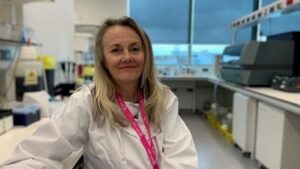
Director of the Cancer Research UK National Biomarker Centre, Professor Caroline Dive, said:
“Our study highlights the growing potential of advanced biomarker science, combined with machine learning, to detect cancers that were previously hard to track in the bloodstream. That’s an exciting development not only for Ewing sarcoma, but for other cancers with similar challenges.
“This is our first liquid biopsy development for children’s cancers, and we are delighted to have made this contribution to such an important area of research and what is a priority for Cancer Research UK. We are grateful to the Children’s Cancer Research Fund (aka Friends of Rosie) who contributed to the funding for our study and are highly motivated to do more to improve treatment for children and young adults with cancer”.
About Ewing sarcoma
Around 55 children and young people are diagnosed with Ewing sarcoma each year in the UK. Only 6 out of 10 will survive for five years or more after being diagnosed**, and this number can be significantly lower if the cancer has already spread or comes back after treatment.
One of the biggest risks to patients is relapse — a return of the disease following treatment. While the impact of earlier detection on outcomes in Ewing sarcoma is still being studied, evidence from other cancers suggests that identifying relapse earlier may support more timely treatment and improved outcomes.

Professor of paediatrics and young adult cancer at the University of Manchester and honorary consultant at the Christie NHS Foundation Trust, Martin McCabe, said:
“The use of liquid biopsies to monitor treatment success and screen for early relapse is a major focus of the international Ewing sarcoma community. This project is an important and exciting step towards developing a clinically validated blood test that could either complement the time-consuming and cumbersome scans and x-rays we currently use or ultimately replace them.”
The blood test uses a machine learning model called EwingSign to spot patterns in DNA fragments, rather than searching for single mutations. By reading these “fingerprints” left behind by the tumour, the test can distinguish cancer DNA from normal DNA, potentially providing a sensitive and minimally invasive way to track the disease over time.
In the study, the test detected signs of cancer in 15 of the 18 patients whose cancer had already come back. The samples were collected just after doctors had confirmed the relapse using standard scans, so while this shows the test is sensitive enough to detect tumour DNA, more research is needed to confirm whether it could identify cancer returning earlier than current monitoring methods.
Current scans can sometimes miss very small or hidden tumours. Around one in three patients whose Ewing sarcoma hasn’t spread, and up to four in five whose cancer has spread, may see the disease come back. Relapses in the first two years after diagnosis tend to be harder to treat***.
The researchers say future studies could look at a combination of different signals in the blood, including more DNA markers and RNA markers, to make the test more accurate. These studies would also investigate whether this blood test could detect relapse earlier than standard scans and whether this could ultimately improve outcomes for children and young people.